Thursday, February 3, 2022

The UniProt Metal Binding Site Machine Learning Challenge

 We would like to invite the machine learning community to help UniProt by creating 
computational methods to predict metal binding sites across the whole of UniProtKB. 
At present around 17% of curated proteins have annotated metal binding site residues, 
which our curators have carefully identified from the literature or known structures 
from PDB. UniProt identifies the specific amino acid residues that participate in metal
binding sites and also which metal is bound. For example, for the Neurospora crassa
metallothionein protein (shown below) contains 7 cysteine residues involved in binding 
6 copper ions.


When we look at the uncurated TrEMBL section which contains the large majority of known 
protein sequences we see that just 3% of proteins have an annotated metal binding site. 
These annotations are created by a variety of automated annotation methods currently 
used. The difference in coverage between the reviewed (Swiss-Prot) and unreviewed 
(TrEMBL) suggests that there are many millions of missing metal binding site annotations 
in the 225 million TrEMBL sequences.

We would like to invite interested researchers to take part in a challenge to create new 
methods to rapidly predict metal binding site annotations that can be deployed by UniProt
as part of its automatic annotation pipeline. These methods could be completely based on 
sequence data or perhaps incorporate information from known and/or predicted structures. 
Although we don’t want to prejudge what methodology may work, we are particularly keen 
that methods be both accurate and very fast for scalability. All data and software must be 
open and not under restrictive licensing terms.

If you would like to take part in this initiative please register your interest by filling out
 this google form by 18th February 2022. We will then hold a planning meeting with 
the participants to discuss timelines and evaluation of the methods.
 

Thursday, November 25, 2021

Navigating the use of tools on the new UniProt website

                                                 (https://beta.uniprot.org/)


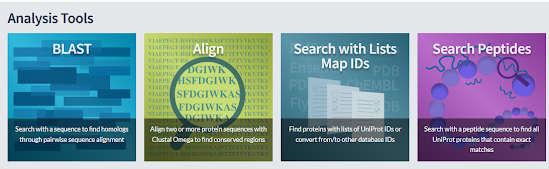
One of the biggest changes we have made on the new UniProt website is to improve your

 usage of the tools associated with our data - BLAST, Align, ID mapping and Peptide 

mapping.

You can easily access all of these from the homepage of the new website,


 or from the toolbar of any entry.


When you open BLAST, you can search by on any UniProtKB ID (e.g. P05067 or 

A4_HUMAN) or a UniParc protein sequence archive ID (e.g. UPI0000000001) to

autofill the protein sequence. One of the biggest changes we have made is to allow 

you to select the species you wish to BLAST against, so if you are only interested in

dog (TaxID:9615), start to type the common (dog) or species (Canis lupus familiaris) 

name and the autocomplete will help you select the correct taxonomic group 

(TaxID:9615), to search for a match. You can choose to limit your search to any 

level of the taxonomic tree, so you can search your dog sequence against, for example,

all mammalian sequences by using the appropriate taxonomic identifier (TaxID:40674).


You can also upload a list of sequences to BLAST, up to a maximum of 20, from an 

external file. You can reset the BLAST parameters, should you wish, and name your 

job so you can easily identify when you return in up to a week's time.


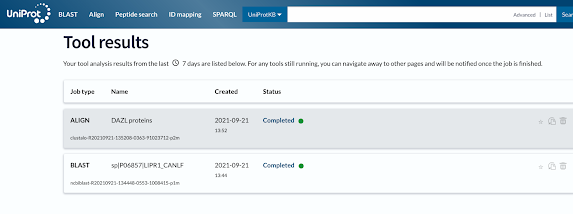
Once your job has run,, it will appear in the new Tool Results view. Here you can see 

all of your  jobs that have completed over the last 7 days, identified by the names you 

have chosen to give them. 


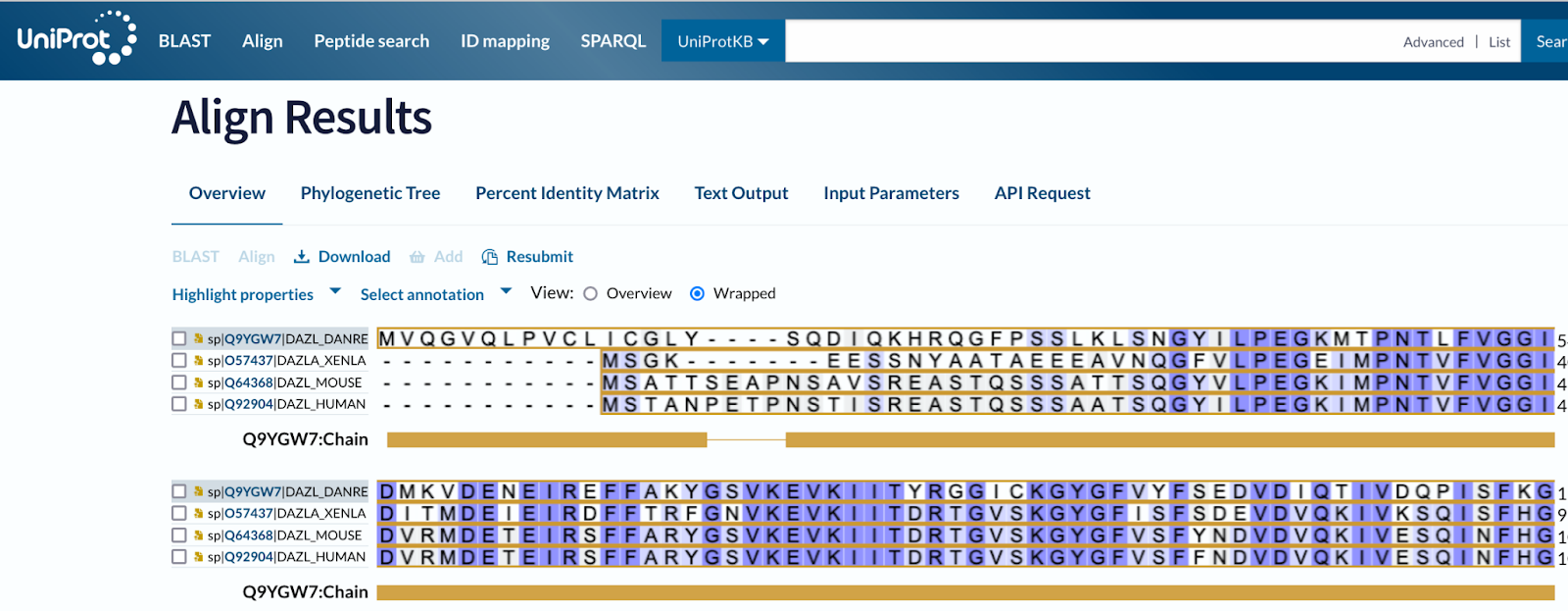
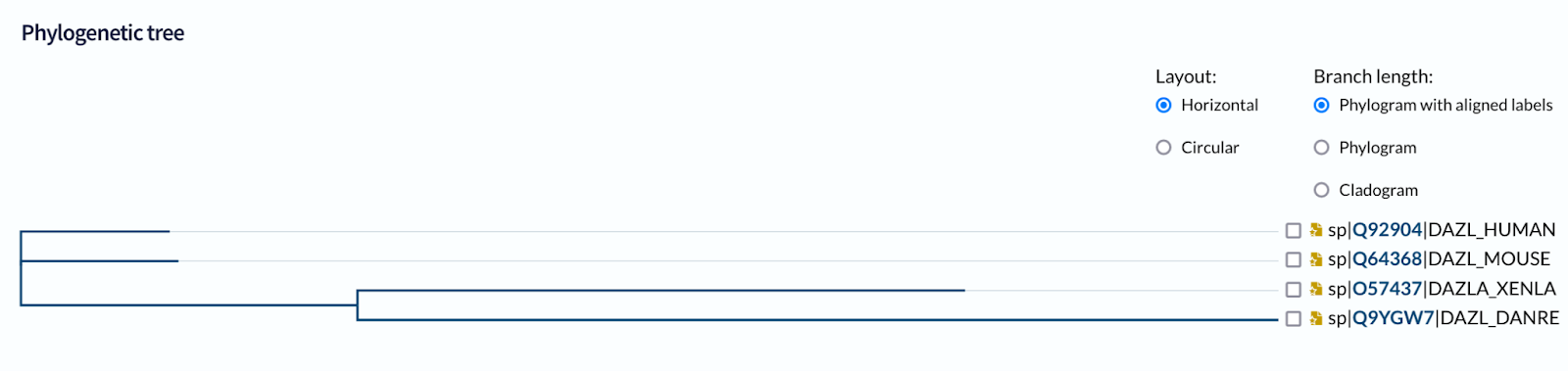
When you open your job, we have increased the number of ways you can view the results.

 For example, in the case of a Sequence Alignment, you can take a look at the traditional 

view of the aligned amino acids, with a summary of any one of the entries you select acting 

as a reference sequence below, or you can see a phylogenetic view or a percent identity 

matrix.


Loading data from a file (up to a maximum of 100 sequences) and restricting the search

criteria by species are features also available in the Peptide Search tool, where users, 

for example proteomics scientists, can match peptide to protein, and an increasing 

number of database identifiers are now available in the ID mapping tool for users to 

switch between.


We hope you find this first look at the new beta version of the UniProt website useful, 

and easy to navigate. Please let us know if you have any problems at all, or if you can 

think of any way in which it can be further improved by using the contact form accessible 

from every page.